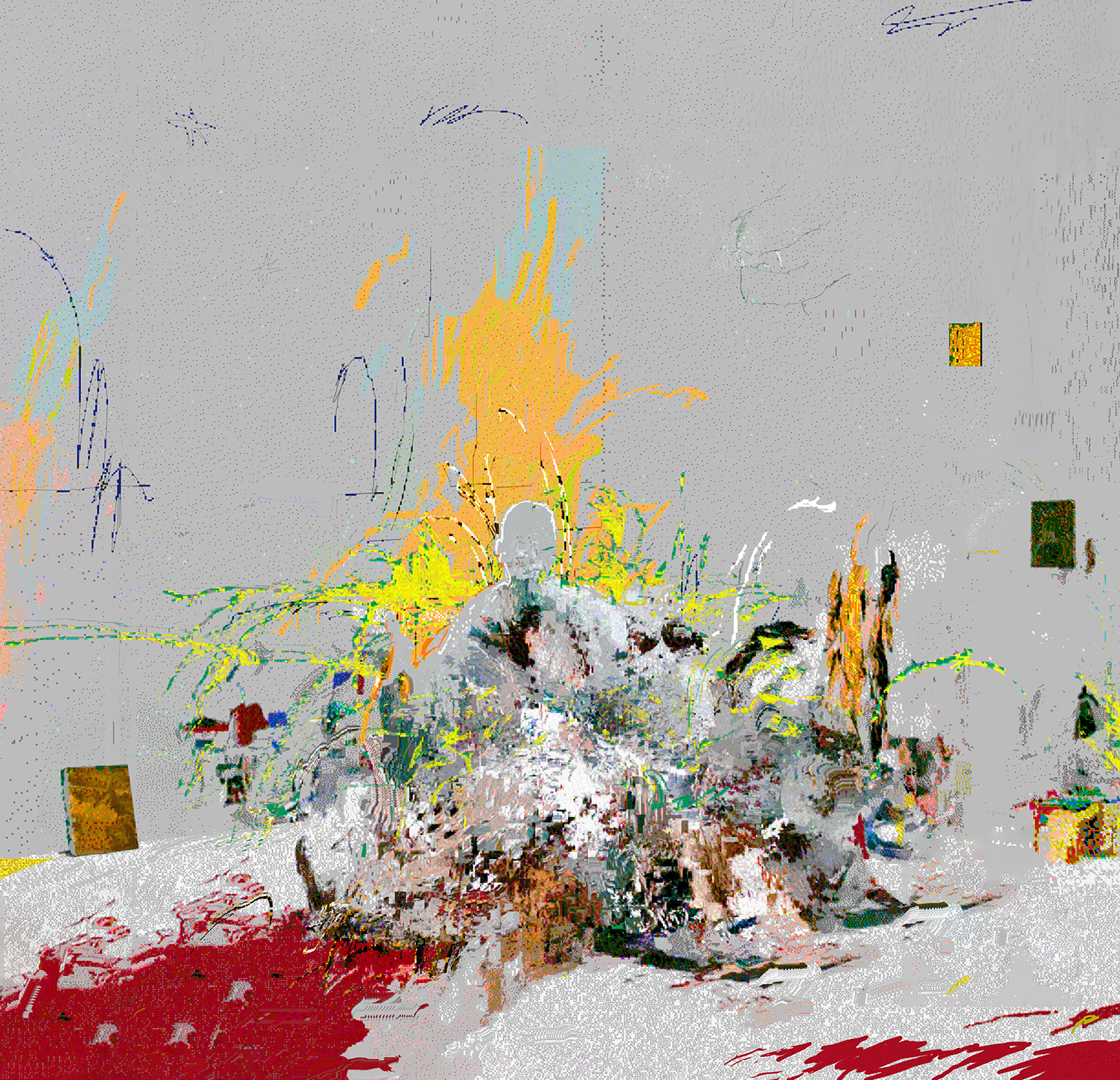
Optimist, Ilya Bliznets
Behind the eternal question of whether art reflects what happens in the world or actively shapes it lies a more fundamental convention: the understanding of art as a distinct layer of existence concerned with the visible universe.
This observation takes on an entirely different character when considered through the idea of computation, which is becoming ever more central to our lives. What is new is the possibility of treating the event of observation—the interaction between vision, understood as biological retinal sensitivity and neural processing, and the information carried by light—as a process that can, in essence, be rationalised and modelled even before we arrive at the practical discussion. For the arts, this is a transformative proposition.
From this perspective, there is no fundamental difference between an image displayed on a screen, encoded as a sequence of zeros and ones in a JPEG file, and a four-by-four-metre oil painting hanging in the Louvre. Both are forms of visual information and, as such, data objects—with one fundamental distinction.
That distinction lies in the “open” nature of the digital format. A digital artefact cannot, strictly speaking, be read directly by the human eye. It requires an interpretative layer, usually a screen, to render it visible. Unlike a traditional medium, this makes it far more fluid: virtually dematerialised, logistically mobile, easier to preserve and, perhaps most importantly, infinitely more open to management. Technically speaking: procedural.
A digital artist does not simply “begin” or “finish” a work. The work fluctuates in a permanent state of modification, reuse and transformation. (Winking at @strakts’ “almost-final states, semi-final versions”.)
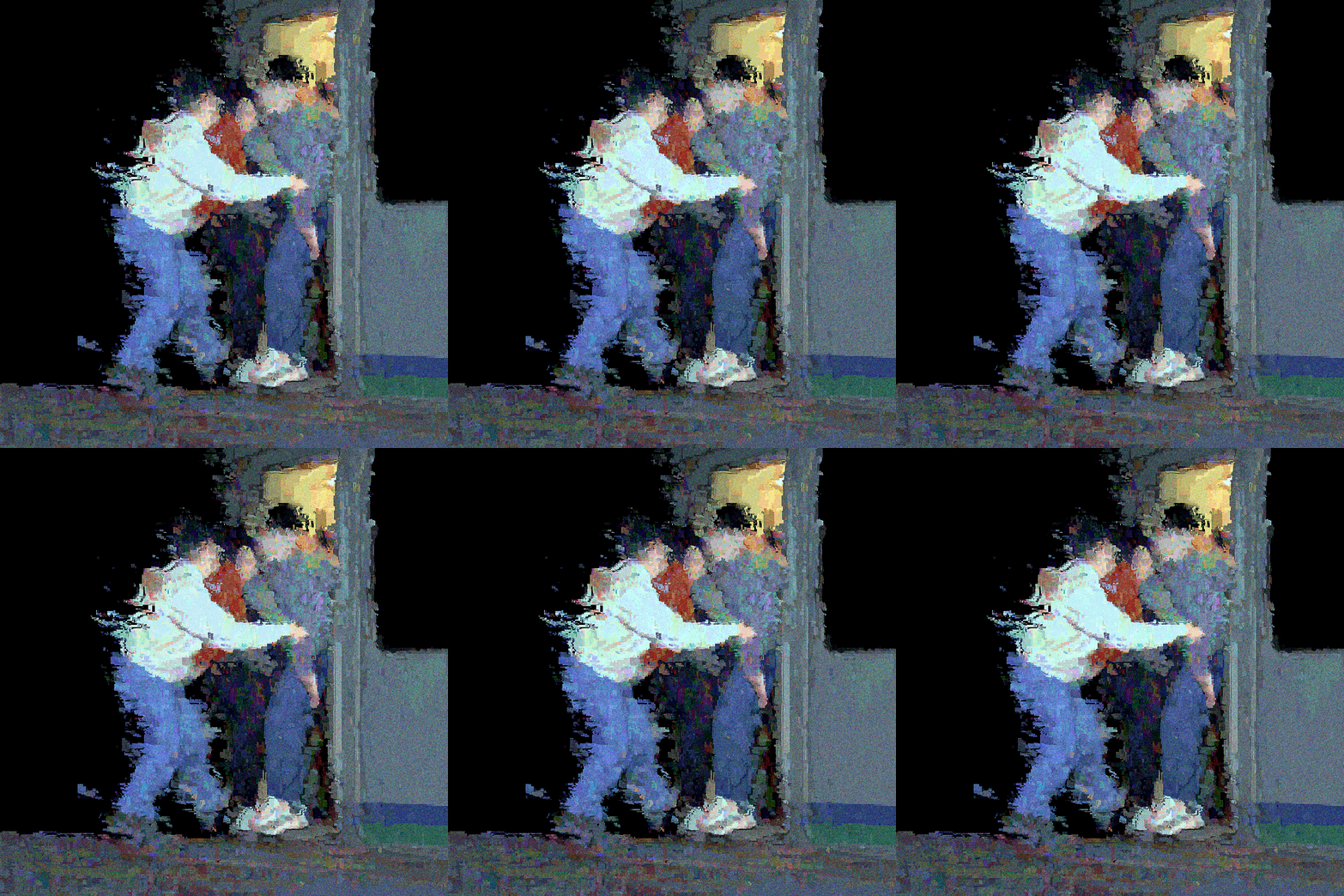
Friction, blvnk
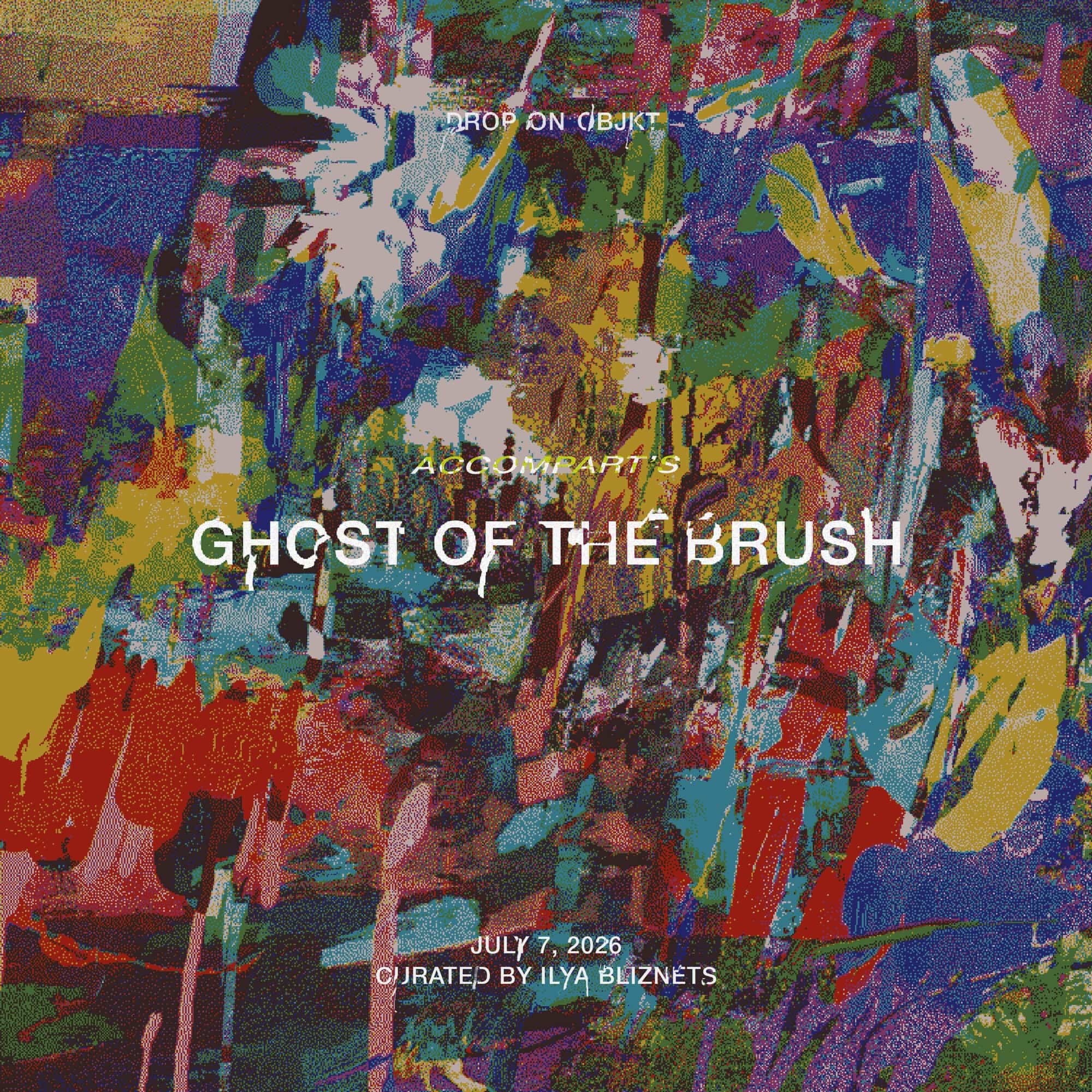
In my view, this is the essential perspective from which to approach the relationship between “physical art” and its seemingly ethereal digital counterpart. It is also the perspective explored by Ghost of the Brush, curated by Ilya Bliznets for @accomparts—an auction? an exhibition? a publication? Such is the nature of the digital—in which I have the honour of participating.
For those who may have missed the reference in the title, it is a nod to the thunderous opening line of Karl Marx and Friedrich Engels’s 1848 The Communist Manifesto: “A spectre is haunting Europe—the spectre of communism.”
I will not argue here that our modest subcultural event heralds a revolution in art. Nevertheless, I believe there is more at stake in its premise than merely the exhibition’s stated interest in “painterly practice in the digital age.” Aesthetics is only one side of the coin.
The crucial point is that, although content—the non-social-media kind—still matters, the challenge posed to traditional media has itself become central to certain contemporary artistic practices. The conversation is no longer:
“We are art too—why will you not accept us?”
It has become:
“You have always claimed to speak meaningfully to people. But what meaning can you possess if you are incapable even of recognising your own limitations?”
In other words: give me digital or give me death.
Go and look at the works. Some of them may even help shape what hangs in the Louvre one day—or… what the Louvre eventually hangs inside.
¡HASTA LA VICTORIA SIEMPRE!